
The Convenience Food Revolution in India
Walk into any supermarket in India today, and you will see shelves overflowing with products promising the same thing: quick, convenient food. From heat-and-eat curry pouches to 30-second meal mixes, the options seem endless. But here is what most people don’t realise: not all convenience foods are created equal.
The terms ready-to-eat food and instant food are often used interchangeably by consumers, retailers, and even food manufacturers. Yet, they represent fundamentally different product categories with distinct preparation methods, nutritional profiles, and use cases. Understanding the difference between ready-to-eat food vs instant food is not just a matter of semantics—it is about making informed choices that align with your lifestyle, dietary needs, and culinary preferences.
Consider this: a retort pouch of dal makhani that takes 2 minutes to heat and an instant sattu meal that takes 30 seconds to mix with normal water are both “convenient foods.” But the journey from raw ingredients to your plate is entirely different. One is fully cooked, sealed, and sterilised using high heat; the other is a minimally processed flour that requires final preparation by you. This fundamental distinction between ready-to-eat food vs instant food affects everything from nutrition to convenience to cost.
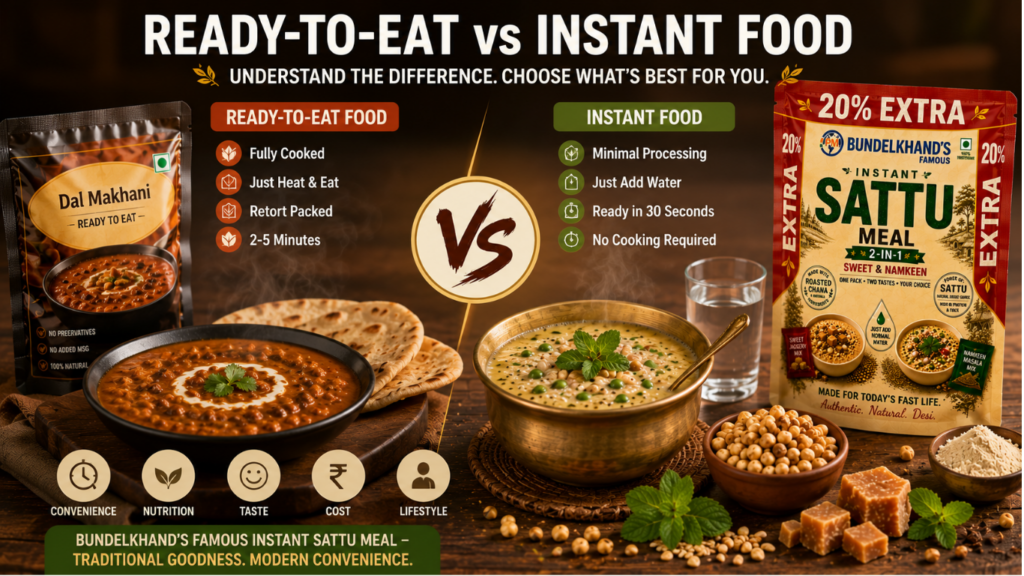
In India, the convenience food market is undergoing a significant transformation. Research shows that convenience-led meal solutions are seeing 25% growth in searches across urban India, while tiffin services have grown by 55% in cities like Ranchi, Jaipur, and Bhopal. This surge in demand reflects changing lifestyles, urbanisation, and a growing need for meal solutions that fit into busy schedules. As more consumers explore the differences between ready-to-eat food vs instant food, the market is responding with innovative products that bridge the gap between tradition and convenience.
But with this explosion of options comes confusion. What should you choose when you are travelling? What is healthier for your daily routine? What offers the best value for money? What aligns with your dietary preferences? Understanding the comparison between ready-to-eat food vs instant food is the first step toward making better food choices.
This comprehensive guide will answer these questions and more. We will explore the fundamental differences between ready-to-eat food vs instant food, examine their nutritional profiles, compare their convenience factors, and help you make the right choice for your specific needs. We will also examine how Bundelkhand’s Famous Instant Sattu Meal represents a new category of traditional Indian instant food—one that combines ancient wisdom with modern convenience. By the end of this guide, you will have a clear understanding of the ready-to-eat food vs instant food debate and know exactly which option works best for your lifestyle.
What Is Ready-to-Eat Food? A Complete Definition
Understanding Ready-to-Eat (RTE) Food
Ready-to-eat foods, as the name suggests, are fully cooked meals that require no further preparation before consumption. These foods are designed to be eaten directly from the package, though some may benefit from gentle heating for an enhanced eating experience. When comparing ready-to-eat food vs instant food, this is the most fundamental distinction: ready-to-eat food requires zero preparation.
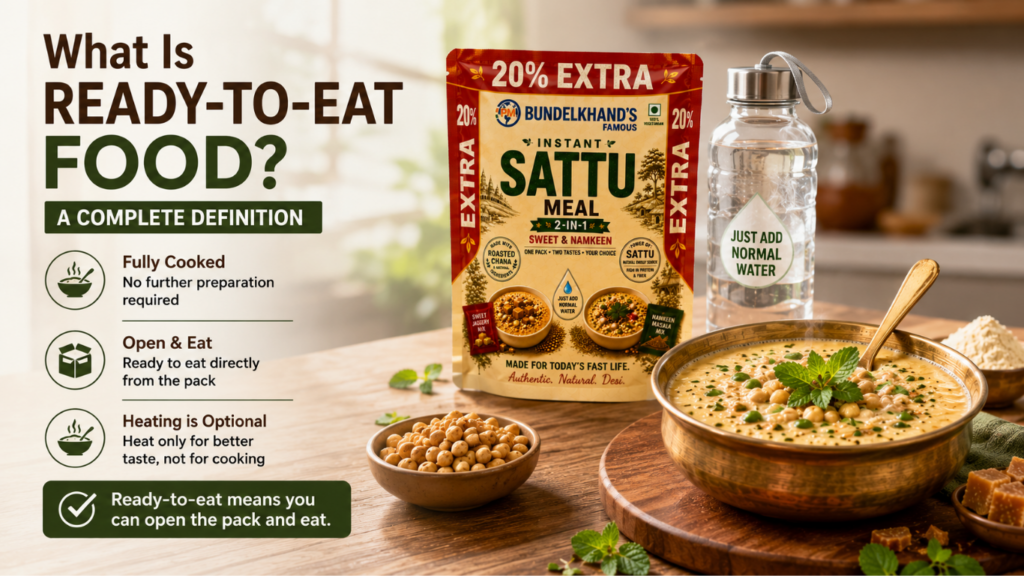
The simple definition: Ready-to-eat means you can open the pack and eat. If heating is required, it’s only for improving taste—not for cooking the food . This is a key factor when considering ready-to-eat food vs instant food because it determines how much effort you need to invest before eating.
Key Characteristics of Ready-to-Eat Food
| Characteristic | Explanation |
|---|---|
| Fully Cooked | The food has undergone complete cooking during manufacturing |
| No Cooking Required | You don’t need to cook, boil, or add water |
| Minimal Effort | Open the pack and eat, or heat briefly in microwave |
| Instant Consumption | Can be eaten immediately after opening |
| Packaged | Comes in sealed pouches, cans, or trays |
| Shelf-Stable Options | Some require refrigeration; others have long shelf life |
Common Examples of Ready-to-Eat Food
| Category | Examples |
|---|---|
| Indian Curries | Dal makhani, paneer butter masala, palak paneer |
| Rice Dishes | Ready rice meals, biryani, pulao |
| Soups | Packaged soups in pouches |
| Canned Foods | Canned vegetables, beans, fruits |
| Chilled Items | Packaged salads, sandwiches |
| Traditional Snacks | Chips, cookies, protein bars, nut crackers |
How Ready-to-Eat Food Is Made: The Technology Behind It
Not all ready-to-eat food is made the same way. The preservation technology used significantly impacts taste, texture, and nutrition. Understanding this helps in the ready-to-eat food vs instant food comparison.
1. Retort Technology (Most Common)
This is the most prevalent method for Indian ready-to-eat meals. The process involves:
- Cooking the food
- Sealing it in a pouch or tray
- Sterilising it at high temperatures (around 121°C)
What this means: The food becomes shelf-stable, but high heat can affect flavour, texture, and nutrients. Texture often becomes soft or mushy. Modern retort technology can preserve food without artificial preservatives.
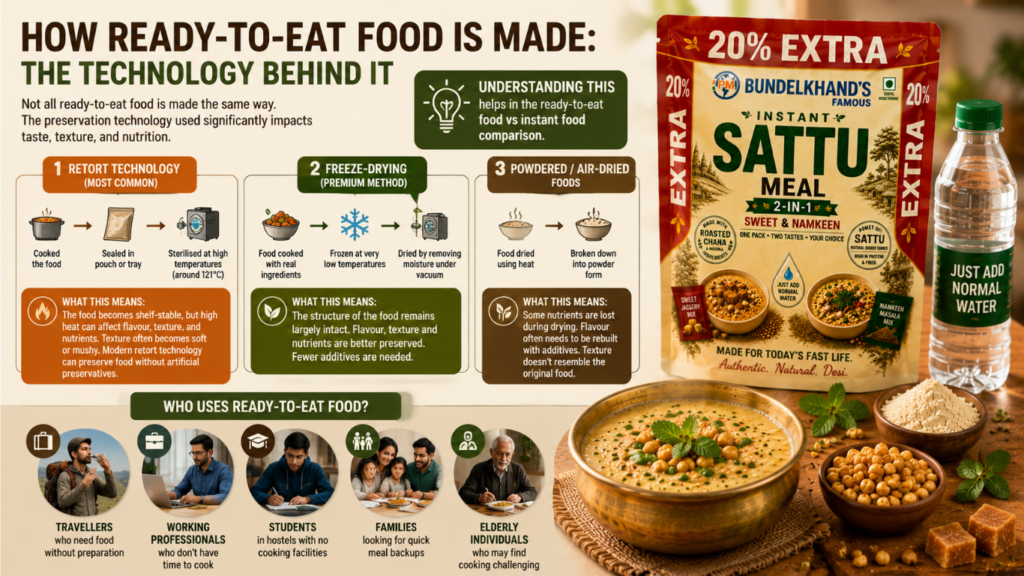
2. Freeze-Drying (Premium Method)
Freeze-drying takes a different approach:
- Food is cooked using real ingredients
- Frozen at very low temperatures
- Dried by removing moisture under vacuum
What this means: The structure of the food remains largely intact. Flavour, texture and nutrients are better preserved. Fewer additives are needed.
3. Powdered/Air-Dried Foods
This method is used for soup powders and ready mixes:
- Food is dried using heat
- Broken down into powder form
What this means: Some nutrients are lost during drying. Flavour often needs to be rebuilt with additives. Texture doesn’t resemble the original food.
Who Uses Ready-to-Eat Food?
Ready-to-eat food is popular among:
- Travellers who need food without preparation
- Working professionals who don’t have time to cook
- Students in hostels with no cooking facilities
- Families looking for quick meal backups
- Elderly individuals who may find cooking challenging
Advantages and Limitations of Ready-to-Eat Food
Advantages:
| Advantage | Why It Matters |
|---|---|
| Zero Preparation | Open and eat—no cooking, no mixing, no waiting |
| Portable | Perfect for travel, office, and on-the-go consumption |
| Consistent Quality | Standardised taste every time |
| Long Shelf Life | Can be stored for extended periods (especially retort-packed) |
| Variety | Wide range of cuisines and dishes available |
Limitations:
| Limitation | Why It’s a Concern |
|---|---|
| Less Control | You cannot adjust consistency or seasoning |
| Heat Processing | May affect nutritional value and texture |
| Heavier | Includes water/liquid weight |
| Cost | Generally more expensive than instant foods |
| Packaging | More packaging waste |
What Is Instant Food? A Complete Definition
Understanding Instant Food
Instant food refers to food products that are partially prepared and require a final preparation step by the consumer before consumption. These products are designed to be quick and easy to prepare, but they are not ready to eat directly from the package. In the debate of ready-to-eat food vs instant food, instant food represents the middle ground between raw ingredients and fully prepared meals.
The simple definition: Instant means you complete the final preparation step—adding water, mixing, stirring—before eating. This is a crucial distinction when comparing ready-to-eat food vs instant food because it affects how much control you have over the final product.
Key Characteristics of Instant Food
| Characteristic | Explanation |
|---|---|
| Partially Prepared | Some cooking or processing has been done |
| Requires Final Step | You must add water, mix, or heat |
| Quick Preparation | Usually takes 30 seconds to 5 minutes |
| Lightweight | Dry format without water content |
| Portable | Easy to carry and store |
| Customizable | You can adjust consistency and add ingredients |
Common Examples of Instant Food
| Category | Examples |
|---|---|
| Indian Traditional | Instant sattu meal, instant poha, instant upma |
| Noodles | Instant noodles, cup noodles |
| Porridge/Cereal | Instant oats, porridge mixes |
| Beverages | Ready-to-mix drinks, protein shakes |
| Soup Mixes | Instant soup powders |
| Breakfast Mixes | Instant idli, dosa, batter mixes |
How Instant Food Is Made
Instant foods are typically made by:
- Cooking or partially cooking ingredients
- Drying them (using heat or freeze-drying)
- Grinding into powder or forming into shapes
- Packaging in dry, shelf-stable formats
For Traditional Indian Instant Foods like Sattu:
The process is simpler:
- Chana (Bengal gram) is roasted
- Ground into flour
- Packaged without additives
- Consumer adds water and mixes
Who Uses Instant Food?
Instant food is popular among:
- Students in hostels with no cooking facilities
- Travellers who need lightweight, portable food
- Working professionals who want quick meals
- Families looking for backup meal options
- Health-conscious consumers choosing traditional options
Advantages and Limitations of Instant Food
Advantages:
| Advantage | Why It Matters |
|---|---|
| Lightweight | Dry format reduces carrying weight |
| Cost-Effective | Generally more affordable than RTE |
| Customizable | Adjust consistency, add extra ingredients |
| Long Shelf Life | Can be stored for months without refrigeration |
| Minimal Processing | Traditional options like sattu have minimal additives |
| Freshly Made Feel | You prepare it fresh when eating |
Limitations:
| Limitation | Why It’s a Concern |
|---|---|
| Requires Preparation | Need water and a bowl—not ready to eat |
| Requires Effort | Mixing and stirring needed |
| May Require Hot Water | Many instant foods need hot water |
| Consistency Varies | Depends on how you prepare it |
| Less Convenient | Not as immediate as RTE |
Ready-to-Eat Food vs Instant Food: Detailed Comparison
At a Glance Comparison
When examining ready-to-eat food vs instant food, the differences are clear across multiple dimensions. Here is a comprehensive comparison of ready-to-eat food vs instant food:
| Aspect | Ready-to-Eat Food | Instant Food |
|---|---|---|
| Definition | Fully cooked, can be eaten directly | Requires final preparation step |
| Preparation | Open and eat (or heat briefly) | Add water/mix/stir |
| Cooking Required | None | Minimal (add water, stir) |
| Water Needed | No | Usually yes |
| Heating | Optional (for taste) | Often required (hot water) |
| Weight | Heavier (includes water) | Lightweight (dry format) |
| Price | Generally more expensive | Generally more affordable |
| Customization | Limited | High |
| Shelf Life | Variable; some need refrigeration | Generally long |
| Additives | May include thickeners, stabilisers | Often minimal in traditional options |
| Examples | Dal makhani pouches, canned soup | Instant sattu, instant noodles, instant upma |
Which Is Better for Travelling? A Ready-to-Eat Food vs Instant Food Analysis
| Factor | Ready-to-Eat Food | Instant Food |
|---|---|---|
| Portability | Heavier, more volume | Lightweight, compact |
| Preparation | Open and eat—zero prep | Need water and a bowl |
| Spillage Risk | High (liquids) | Low (dry format) |
| Cost | More expensive | More affordable |
| Weight | Heavier | Lighter |
| Mess | Minimal | Minimal (if prepared with care) |
Winner for Travel: Instant Food (for its lightweight, compact, mess-free format)
Which Is Better for Students in Hostels? A Ready-to-Eat Food vs Instant Food Analysis
| Factor | Ready-to-Eat Food | Instant Food |
|---|---|---|
| Kitchen Access | Not required | Not required |
| Water Required | Not required | Water needed |
| Hot Water Needed | Not required | Often needed (not always available) |
| Cost | More expensive | More affordable |
| Storage | Can stock up | Can stock up |
| Flexibility | Limited | High (can add extras) |
| Nutrition | Varies (retort processing affects nutrition) | Varies (traditional options are nutrient-dense) |
Winner: Depends on water availability. Instant Sattu Meal (normal water) is perfect for hostels.
Which Is Better for Nutrition? A Ready-to-Eat Food vs Instant Food Comparison
| Aspect | Ready-to-Eat Food | Instant Food |
|---|---|---|
| Processing | High heat processing affects nutrients | Generally less processed (especially traditional options) |
| Additives | May contain thickeners, stabilisers | Traditional options have minimal additives |
| Control | You cannot control ingredients | You can add to it |
| Protein Content | Varies | Traditional options like sattu have 20-25% protein |
| Preservatives | Retort technology can be preservative-free | Traditional options often preservative-free |
Winner: Instant Food (especially traditional options like sattu that are minimally processed)
Which Is Better for Convenience? A Ready-to-Eat Food vs Instant Food Comparison
| Factor | Ready-to-Eat Food | Instant Food |
|---|---|---|
| Time to Eat | 0 seconds (immediate) | 30 seconds to 5 minutes |
| Effort Required | Minimal (open pack) | Some effort (mix, stir) |
| Equipment Needed | None (or microwave) | Bowl, spoon, water |
| Cleanup | Minimal (throw away packaging) | Minimal (wash bowl) |
Winner: Ready-to-Eat (for zero-effort convenience)
The Indian Context: How Ready-to-Eat and Instant Foods Are Transforming Indian Eating Habits
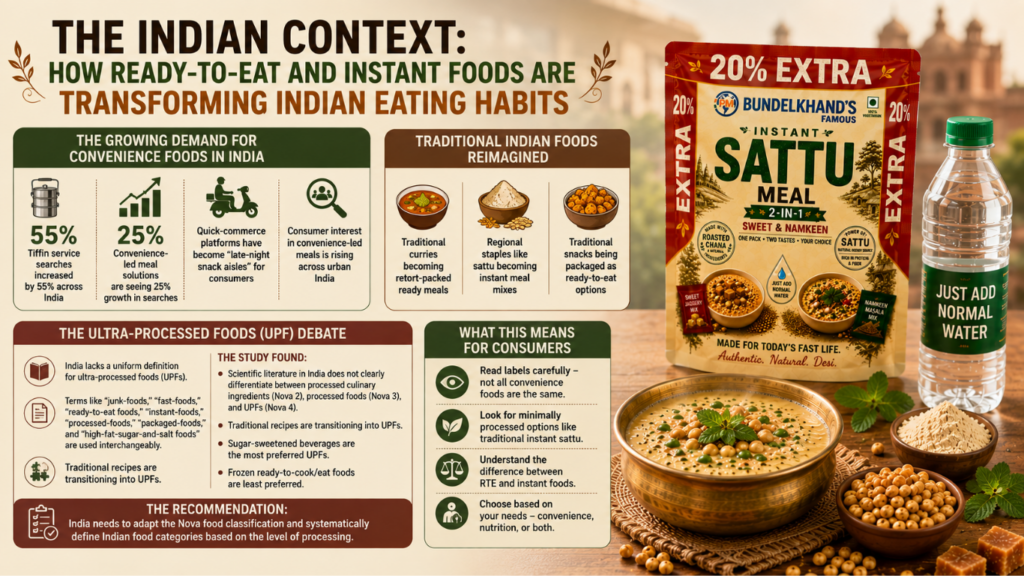
The Growing Demand for Convenience Foods in India
India is witnessing a significant shift in food consumption patterns:
- Tiffin service searches increased by 55% across India
- Convenience-led meal solutions are seeing 25% growth in searches
- Quick-commerce platforms have become “late-night snack aisles” for consumers
- Consumer interest in convenience-led meals is rising across urban India
Traditional Indian Foods Reimagined
One of the most interesting trends is the adaptation of traditional Indian foods into modern convenience formats. Research shows that traditional recipes are transitioning into ultra-processed and convenience foods in the Indian market.
This includes:
- Traditional curries becoming retort-packed ready meals
- Regional staples like sattu becoming instant meal mixes
- Traditional snacks being packaged as ready-to-eat options
The Ultra-Processed Foods (UPF) Debate
A 2024 study published in BMC Public Health highlighted a critical issue: India lacks a uniform definition for ultra-processed foods (UPFs). Currently, terms like “junk-foods,” “fast-foods,” “ready-to-eat foods,” “instant-foods,” “processed-foods,” “packaged-foods,” and “high-fat-sugar-and-salt foods” are all used interchangeably to denote UPFs.
The study found:
- Scientific literature in India does not clearly differentiate between processed culinary ingredients (Nova food group 2), processed foods (Nova food group 3), and UPFs (Nova food group 4)
- Traditional recipes are transitioning into UPFs
- Sugar-sweetened beverages are the most preferred UPFs
- Frozen ready-to-cook/eat foods are least preferred
The recommendation: India needs to adapt the Nova food classification and systematically define Indian food categories based on the level of processing.
What This Means for Consumers
For Indian consumers, this means:
- Read labels carefully—not all convenience foods are the same
- Look for minimally processed options like traditional instant sattu
- Understand the difference between RTE and instant foods
- Choose based on your needs—convenience, nutrition, or both
The Technology Behind Your Food: How Processing Matters
Understanding Food Processing Technologies
Not all convenience foods are processed the same way. The preservation technology used significantly impacts the final product.
1. Retort Processing (Most Common for RTE)
What It Is:
- Food is cooked, sealed in a pouch, and heated at high temperatures
- Temperatures reach around 121°C (250°F)
Impact on Food:
- The food becomes shelf-stable for months
- High heat can affect flavour, texture, and nutrients
- Texture often becomes soft or mushy
- Additives like thickeners or stabilisers may be used
Common Products:
- Dal makhani pouches
- Ready rice meals
- Packaged curries
- Soups
Good News: Retort technology can preserve food without artificial preservatives.
2. Freeze-Drying (Premium Technology)
What It Is:
- Food is cooked using real ingredients
- Frozen at very low temperatures
- Dried by removing moisture under vacuum
Impact on Food:
- The structure of the food remains largely intact
- Flavour, texture and nutrients are better preserved
- Fewer additives are needed
- The food remains lightweight and shelf-stable
Common Products:
- Premium ready meals
- Adventure/travel food
- Some Indian instant meal brands
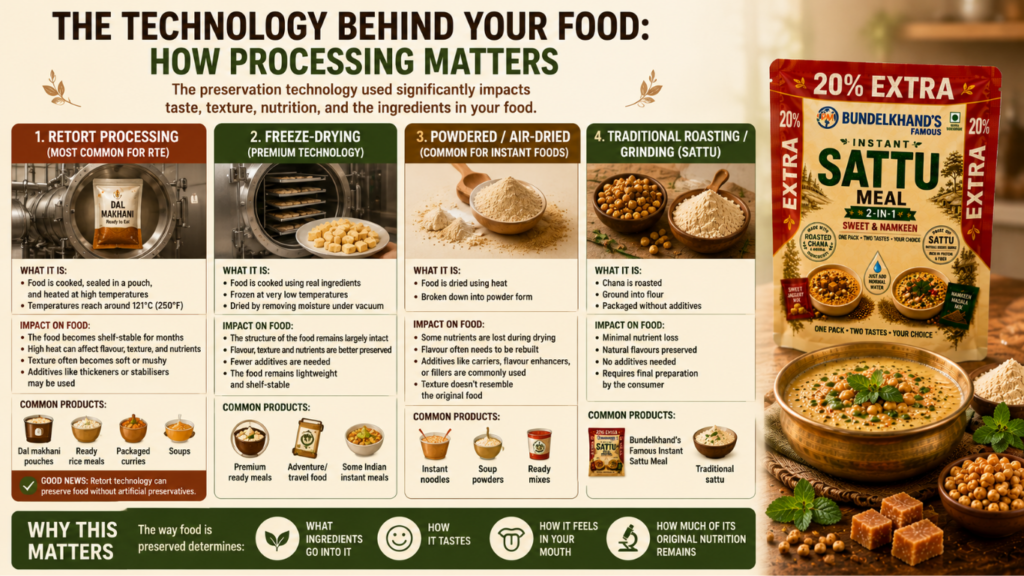
3. Powdered/Air-Dried (Common for Instant Foods)
What It Is:
- Food is dried using heat
- Broken down into powder form
Impact on Food:
- Some nutrients are lost during drying
- Flavour often needs to be rebuilt
- Additives like carriers, flavour enhancers, or fillers are commonly used
- Texture doesn’t resemble the original food
Common Products:
- Instant noodles
- Soup powders
- Ready mixes
4. Traditional Roasting/Grinding (Sattu)
What It Is:
- Chana is roasted
- Ground into flour
- Packaged without additives
Impact on Food:
- Minimal nutrient loss
- Natural flavours preserved
- No additives needed
- Requires final preparation by the consumer
Common Products:
- Bundelkhand’s Famous Instant Sattu Meal
- Traditional sattu
Why This Matters
The way food is preserved determines:
- What ingredients go into it
- How it tastes
- How it feels in your mouth
- How much of its original nutrition remains
Bundelkhand’s Famous Instant Sattu Meal: A New Category of Traditional Indian Instant Food
What Makes It Different?
Bundelkhand’s Famous Instant Sattu Meal represents a new category of convenience food that combines ancient Indian food wisdom with modern consumer needs.
Key Differentiators:
| Aspect | Bundelkhand’s Famous Instant Sattu Meal | Other Instant Foods | Ready-to-Eat Foods |
|---|---|---|---|
| Base | Traditional roasted chana sattu | Often highly processed | Varies |
| Preparation | Normal water, 30 seconds | Hot water usually required | Open and eat |
| Additives | Minimal (jaggery, masala) | Often has additives, thickeners, flavour enhancers | May have stabilisers |
| Nutrition | 20-25% protein, high fibre | Varies | Varies |
| Processing | Minimal (roasting + grinding) | Often heavily processed | Retort processing |
| Customization | High (adjust consistency) | Limited | None |
| Traditional | Yes | Often not | Varies |
Why It Fits Both Categories Differently
Bundelkhand’s Famous Instant Sattu Meal is a traditional instant food, not a ready-to-eat product. This distinction is important because:
It’s Instant Food Because:
- Requires final preparation (add water, stir)
- Not ready to eat directly from the package
- Consumer completes the final step
It’s Not Ready-to-Eat Because:
- Not fully cooked or prepared
- Requires the consumer to mix
- Cannot be eaten directly from the pack
The Health Advantage
A 2024 research study on ultra-processed foods in India noted that terms like “ready-to-eat foods” and “instant-foods” are often used interchangeably with “ultra-processed foods”. However, traditional instant foods like sattu challenge this assumption.
Bundelkhand’s Famous Instant Sattu Meal is:
- Minimal processed (only roasted and ground)
- Free from preservatives
- No artificial additives
- Made from a single, natural ingredient (roasted chana)
- Traditional—consumed for centuries
This is in stark contrast to retort-processed ready-to-eat meals, which may contain thickeners and stabilisers.
Ready-to-Eat Food Myths vs Facts
Myth 1: All Ready-to-Eat Foods Are Unhealthy
Fact: Not all ready-to-eat foods are loaded with preservatives and high sodium. Leading Indian food manufacturers focus on creating balanced meals consisting of natural ingredients.
What to Look For:
- Clean ingredients
- Balanced macros
- Minimal sodium
- Check the label
Myth 2: Ready-to-Eat Food is Full of Preservatives
Fact: Modern food technologies like retort help extend product shelf life without any preservatives.
The Technology:
- Retort thermal processing sterilises food
- Destroys bacteria while locking in nutrients
- Allows food to be shelf-stable without preservatives
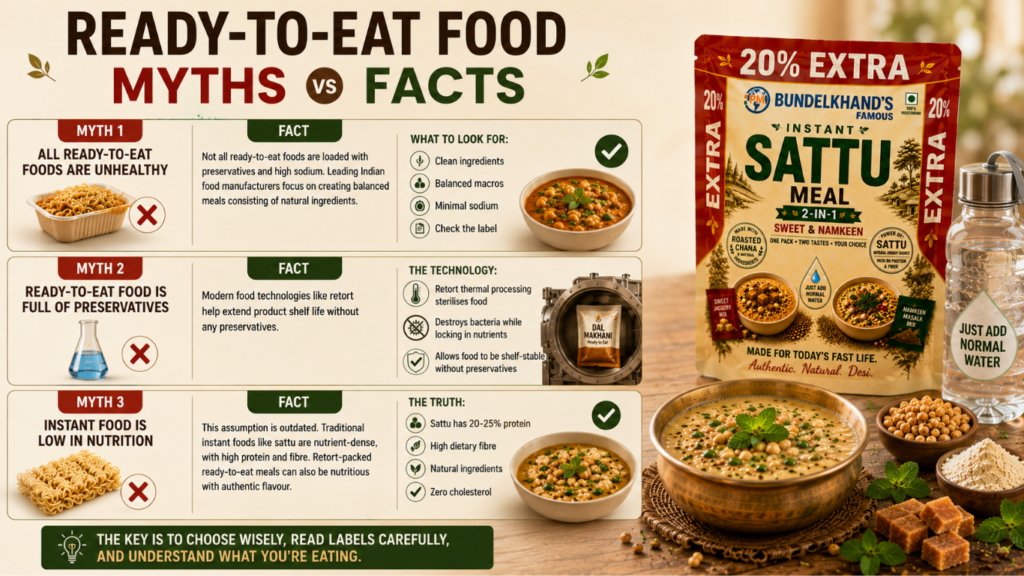
Myth 3: Instant Food is Low in Nutrition
Fact: This assumption is outdated. Traditional instant foods like sattu are nutrient-dense, with high protein and fibre. Retort-packed ready-to-eat meals can also be nutritious with authentic flavour.
The Truth:
- Sattu has 20-25% protein
- High dietary fibre
- Natural ingredients
- Zero cholesterol
How to Choose Between Ready-to-Eat and Instant Food
Decision Framework
| If You Need… | Choose… | Why |
|---|---|---|
| Immediate food with zero prep | Ready-to-Eat | Open and eat |
| Lightweight travel food | Instant Food | Dry format, lighter |
| Budget-friendly option | Instant Food | Generally more affordable |
| Hot, freshly prepared meal | Instant Food | You prepare it fresh |
| Customizable meal | Instant Food | Adjust consistency, add ingredients |
| No water available | Ready-to-Eat | No water needed |
| Traditional Indian food | Instant Sattu Meal | Traditional, minimally processed |
| Long shelf life | Both | Both have good shelf life options |
What the Research Shows
Consumer research on convenience foods shows interesting patterns:
- Convenience is the primary driver for choosing ready-made foods
- Safety and nutrition follow in importance
- High-perception consumers prefer ready-to-cook (RTC) products
- Low-perception consumers prefer ready-to-eat (RTE) products
The Future of Convenience Food
The Indian convenience food market is evolving:
- Health-conscious options are growing
- Traditional foods are being reimagined
- Advanced technologies (freeze-drying) are improving nutrition retention
- Specialised diets (high-protein, low-carb, gluten-free) are becoming available
Frequently Asked Questions About Ready-to-Eat and Instant Food
1. What is the difference between ready-to-eat food and instant food?
Answer: Ready-to-eat food is fully cooked and can be eaten directly from the package. Instant food requires a final preparation step by the consumer, such as adding water, stirring, or heating. Ready-to-Eat Food vs Instant Food.
2. Which is healthier: ready-to-eat or instant food?
Answer: It depends on the specific product. Traditional instant foods like sattu are minimally processed with high protein (20-25%) and fibre. Ready-to-eat food can be healthy if made with clean ingredients and advanced preservation technologies. Always read labels.
3. Can ready-to-eat food be eaten without heating?
Answer: Yes, ready-to-eat food can be consumed directly from the package without heating. Heating is optional and only for taste enhancement.
4. Which is better for travel: ready-to-eat or instant food?
Answer: It depends on your priorities. Ready-to-eat requires no water or preparation. Instant food is lighter, more compact, and more affordable. For weight-conscious travel, instant food is often better. Ready-to-Eat Food vs Instant Food.
5. What is retort technology in ready-to-eat food?
Answer: Retort technology involves cooking food, sealing it in a pouch, and sterilising it at high temperatures (around 121°C). This extends shelf life without preservatives. Ready-to-Eat Food vs Instant Food.
6. Is sattu an instant food or ready-to-eat food?
Answer: Sattu is an instant food because it requires final preparation—mixing with water and stirring—before consumption. Ready-to-Eat Food vs Instant Food.
7. Does ready-to-eat food contain preservatives?
Answer: Not necessarily. Brands using retort technology can extend shelf life without preservatives. Always check the label. Ready-to-Eat Food vs Instant Food.
8. Which is more affordable: ready-to-eat or instant food?
Answer: Instant food is generally more affordable than ready-to-eat food because it doesn’t include the cost of water weight, cooking, and heavy packaging. Ready-to-Eat Food vs Instant Food.
9. What are traditional Indian instant foods?
Answer: Traditional Indian instant foods include sattu, instant poha, and instant upma. These are based on traditional recipes and require minimal preparation. Ready-to-Eat Food vs Instant Food.
10. Can instant food be prepared with normal water?
Answer: Some instant foods require hot water, but products like Bundelkhand’s Famous Instant Sattu Meal are designed to be prepared with normal water—making them perfect for students and travellers. Ready-to-Eat Food vs Instant Food.
11. What is the shelf life of ready-to-eat and instant foods?
Answer: Both can have long shelf lives, ranging from several months to over a year, depending on the product and packaging. Check individual product labels. Ready-to-Eat Food vs Instant Food.
12. Which is better for students in hostels: ready-to-eat or instant food?
Answer: For students in hostels, instant food that can be prepared with normal water (like Bundelkhand’s Famous Instant Sattu Meal) is ideal. No kitchen, no hot water, no cooking needed. Ready-to-Eat Food vs Instant Food.
13. What is freeze-dried food?
Answer: Freeze-dried food is cooked, frozen, and dried under vacuum. The process removes water while preserving the food’s structure, flavour, and nutrients. It’s considered a premium preservation method. Ready-to-Eat Food vs Instant Food.
14. Is traditional instant food healthier than modern instant food?
Answer: Generally, yes. Traditional instant foods like sattu are minimally processed with a single, natural ingredient (roasted chana). Modern instant foods may contain additives, flavour enhancers, and fillers. Ready-to-Eat Food vs Instant Food.
15. Can ready-to-eat food be part of a balanced diet?
Answer: Yes, if you choose products with clean ingredients, balanced macros, and minimal sodium. Reputable brands are transparent about their ingredients. Ready-to-Eat Food vs Instant Food.
Conclusion: Making the Right Choice for Your Lifestyle
The Key Takeaway
Ready-to-eat food and instant food serve different purposes. Neither is inherently better or worse—they are designed for different situations and needs. Understanding the difference between ready-to-eat food vs instant food helps you make better choices for your lifestyle. Ready-to-Eat Food vs Instant Food.
Choose Ready-to-Eat Food When:
- You have zero time or facilities for preparation
- You are in transit and need immediate food
- You don’t have access to water
- You want a fully prepared meal without any effort
Choose Instant Food When:
- You are travelling and need lightweight food
- You are a student in a hostel with no cooking facilities
- You want to control consistency and add extra ingredients
- You prefer a freshly prepared meal
- You want a more affordable option
Choose Bundelkhand’s Famous Instant Sattu Meal When:
- You want traditional Indian food with minimal processing
- You need a high-protein, fibre-rich meal
- You have access to water but not a kitchen
- You want both sweet and savoury options
- You want a meal ready in 30 seconds
Why Bundelkhand’s Famous Stands Out
| Feature | What It Means for You |
|---|---|
| Traditional Base | Roasted chana sattu—trusted for centuries |
| Normal Water | No hot water needed—perfect for travel and hostels |
| 30 Seconds | Faster than any other instant food |
| 2-in-1 | Sweet and Namkeen options for variety |
| High Protein | 20-25% protein—keeps you full |
| Minimal Processing | Only roasted and ground—no additives |
Explore Bundelkhand’s Famous Instant Sattu Meal
Looking for the perfect instant food for your lifestyle?
Discover Bundelkhand’s Famous Instant Sattu Meal – 2-in-1 Sweet & Namkeen.
Just add normal water • Stir • Ready in approx. 30 seconds
[VIEW PRODUCT → Instant Sattu Meal]
About Bundelkhand’s Famous
Bundelkhand’s Famous is focused on bringing traditional regional food ideas into modern formats that are convenient for today’s consumers.
Our Instant Sattu Meal combines roasted chana sattu with Sweet and Namkeen options in a convenient format that fits perfectly into modern lifestyles—whether you are a student, traveller, professional, or busy family. Ready-to-Eat Food vs Instant Food.
Website: https://www.bundelkhandsfamous.com/
Healthy diet guidelines
World Health Organization nutrition guidelines
UPF research in India
research study on ultra-processed foods in India
